#shoppingfortarot (non) VR to LadyKnight of Avalon

Back in October, LadyKnight of Avalon on YouTube did a video where she talked about deck collections and how we go about the process of curating our personal collections over time.    The fact is that I have a rather large deck collection, and not just of tarot but also playing cards, oracle cards, lenormand, and other game cards and cartomancy cards. I love decks of cards.  I love the diversity of artwork available and the variety “voices” that the different styles of artwork speak with.

Anyway, she devised this list of questions for those that shop for and collect decks, no matter the size of your collection.  So here we go….

sage

1. What was the last deck you bought and why that one?

The last deck I bought was the Divine Muses Oracle.  I actually saw this one on Kickstarter when it was being launched, and I waffled on it and ended up not backing it because some of the cards didn’t appeal to me all that much (Ancestors, Astral Ascent, and the Muse of Art cards, for example).   But since then I have seen this deck on many videos and images, and I’ve been SUPER attracted to it and had some of the cards really stand out to me super strongly (such as the Totem of Water, Lattice of the Soul, and Raven King).  In the end, I decided that the cards that really spoke to me outweighed the cards that I was a bit “meh” on and I picked it up to see how I could get on with it.

2. What’s your decision process when you buy a new deck?

Does the imagery on the deck speak to me?  Will the words get in my way? If so, can they be removed?  Is it worth (to me) what they’re asking for the deck?  Can I afford to buy it?  Is it something I want to buy right now, or do I want to wait and see if I still want it in a few weeks?

3. What are deal-breakers in a deck that keep you from buying it?

Well at the top of the list is if I can’t connect with the imagery.  If the imagery doesn’t speak to me then there’s just no point in buying the deck.   Other deal-breakers include a Hanged Man card or Two of Pentacles card that I just can’t work with, super crappy cardstock (I’m a riffle shuffler… if it can’t handle being riffle shuffled then there’s no point in me owning it), too few cards for too much money, or well… too much money in general because if it’s out of my price range?  Then it’s out of my price range.

4. Little white book or big guide book?

I don’t really care as long as there is quality content.  I’ve seen some spectacular little white books…. and I’ve seen some big guide books that are just sheer crap.

5a. Do you have new deck rituals?

Yes.  When I get a new deck, I like to do a cleansing and a deck interview.  Unless I allow others to handle the cards, or for some reason the deck’s communication starts to feel “muddled”, chances are  that this is the only time the deck will ever be cleansed while in my possession.

5b. How do you break in a new deck?

By using them.   Also, meditative shuffling.  And, sometimes, with deck modification as well such as edging and/or trimming the deck if  feel that it needs it.

6a. Have you ever been disappointed after getting a deck because it looked/felt different than expected?

Yes.  Usually this has to do with how it communicates with me.  There have been times I’ve purchased decks and when I get them in my hands I just can’t get them to communicate as clearly as I’d like.   The most prominent example of this is the WildWood Tarot, which has artwork of a theme and style that I felt should have spoken to me very clearly, but even after years of trying, I couldn’t manage to work with them very well.    (It turns out, cutting off the titles on the cards so that it is artwork-only finally solved this issue for me.)

6b. Have you ever been pleasantly surprised by a deck after getting it?)

Yes.   Most recently?  The This Might Hurt deck, which I backed on Kickstarter in the spring and just arrived this week.  It was far and above the quality I was expecting and I’ve been avoiding walk-throughs and other images of the cards, etc because I wanted it to be a surprise.

7. Do you interview new decks?

Usually just when it first comes into my collection, although if I feel that the “tone” of a deck’s readings have changed over time then I will do it again to re-familiarize myself with the energy of the deck and it’s “voice”.

8. Do you ever buy decks for a specific purpose (only using it for that one?)

Yes.  I have a few decks that are solely for my personal use.  I have a few that are solely for shadow work.  And I have a few that I’ve purchased solely to use in one-card draws.

I have also occasionally bought a bootleg deck or two for the purposes of spellwork, because often in those cases the deck is destroyed in some way in the process of the spell casting.  Destroying a $5 deck in a spell is one thing.  Destroying a $50 deck in a spell is quite another.

9. Do you differentiate between decks you buy for yourself and decks you would use for other people?

Only in a few special cases.   The vast majority of my decks are open to be used for both.

10. What is one thing you wish deck creators would do, do more of or stop doing?

Do:  I wish more deck creators would consider cardstock as a top priority. (Hello Llewellyn, I’m talking to you.)

Do More:  I’m all for more illustrated pip cards.  I hate it when you have glorious and beautifully done Majors, and then the Minors are just sparingly done pips; or else they are illustrated, but in a way that makes it clear not as much effort was put into them as the Major Arcana.

Stop Doing: This one is specifically for creators on Kickstarter.  A lot of creators on that platform add on “Stretch Goals” which is great, but I really wish that they would focus less on little trinkets, pins, fancy boxes, etc….. and more on upgrading cardstock and making the actual CARDS nicer.
#BackupDecks (non) VR to The Hermit’s Cave

I’ve been sitting on this post for quite some time, because originally?  I wanted to do pictures of all of these decks.  But it turned out that the pictures were just becoming a HUGE pain in the ass, so I revised the idea and will be sure to add links to each deck so that you can see what they are, but I’m not going to bother taking pictures of them all.

deck03

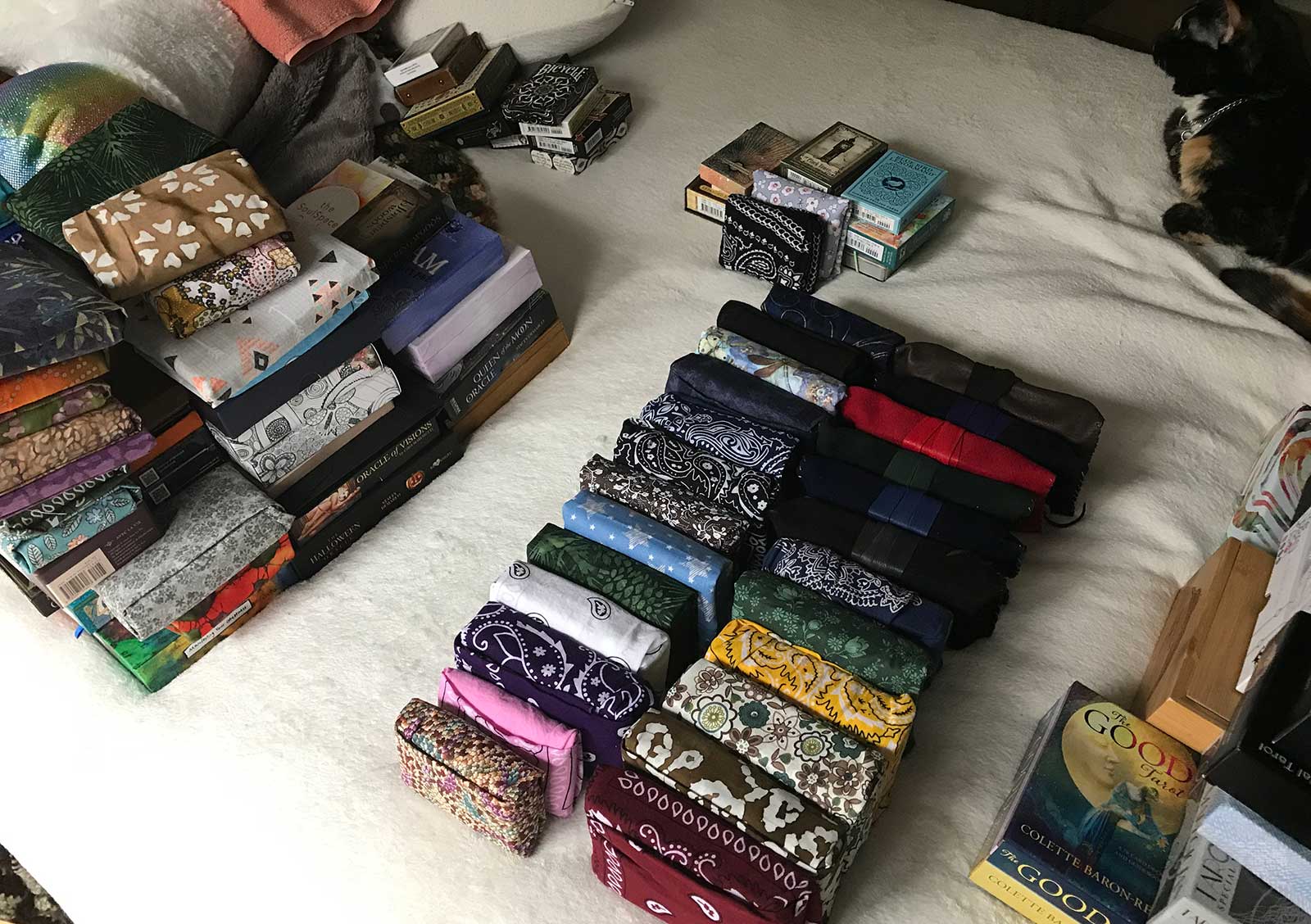
Luna (upper right corner) assisting me in sorting and organizing my decks to be stored in my trunks.

The original theme for this post was created by Simon over at The Hermit’s Cave, where he did a video a few months ago about his backup decks. I had thought that I don’t often purchase back-up decks until I started writing this post. Now? Lets just say it started out with a few decks that I have done so because the deck was just TOO important to me to risk ever being without… and then kind of shifted from there.

In fact, I only have…. hm, three?  No, four, I think.  That is to say, back up decks that are very literally and very much bought -as- back up decks.

Gypsy Witch Fortune Cards – I have the original 1970s version that was given to me as a child as my very first divination deck, and then I also have an old 1920s version that I picked up more recently.

Sasuraibito Tarot – This one is because I already owned a copy and was then gifted a copy by Z a few months after I’d already bought it for myself.  I held onto the second one because I really like the deck so… why not?

Tarot of the Hidden Realm – I’ve mentioned this deck many, many times.  I connected to it from the moment it came out of the box and that connection has only gotten stronger over time. I have a second copy of this deck (and TWO extra guidebooks for it) because I love it so much.

Tyldwick Tarot – I have two of this deck for the same reason as the Tarot of the Hidden realm.  It’s because I love it so much.   And, because it speaks to me in a way I’ve not found any other deck has ever spoken to me before, and I find that it communicates well with ALL of the various Fae themed decks I have.

And, soon to be added, the Stolen Child Tarot, which has quickly stolen second place right behind Tarot of the Hidden Realm as my all time favorite deck.

deck01

The trunks where I home the majority of my decks.  These are located in my bedroom on the far side of the bed beneath the windows.

Aside from those mentioned above, I also have a few that I have two decks for, but it is because I have done some kind of alteration to the deck that has significantly changed how I use it or how it reads, and yet still wanted to retain one for myself in its original format as well.   These include….

Arthur Rackham Oracle – Essentially, I took both decks and picked out the best artwork for each card, added in the cards from both decks that were different, and thus created a giant deck.   With the repeat cards that were left over, I then trimmed them down to just the image and use them as an intuitive oracle deck.

Fairy Lights Tarot – Both of the versions of these I have trimmed, but in different ways.   The first one, I trimmed off just the sides of the deck.  This is because some of the cards fit together to make panoramic views of a larger picture and the side borders made fitting them together impossible.  The second deck I have trimmed down to just the images, and use them as an intuitive oracle deck.

John Bauer Tarot – I have an un-modified version.   And then I have one that I’ve removed all the borders and text, cutting them down to just the images and edging them in multiple colors to match the artwork on each card.  Like the others in this group of decks, I use the trimmed down version as an intuitive oracle deck.

Nicoletta Ceccoli Tarot – I have three versions of this one.  I have an un-modified full size deck, I have the mini pocket size of this deck, and I have a third one that I have trimmed down to just the images to use as an intuitive oracle deck.

deck02

The interior of one of the trunks prior to finishing filling it up.

Ok, so then there’s a third category here… because I also have a handful of decks that I have more than one of that are not back ups, but different versions of the same deck.  These would include…

1971 Rider Waite Deck; plus a newer “mini deck” size copy of it.

Centennial Smith Waite – I have three versions of this one.  That includes the borderless edition, the edition with borders, and the tarot-in-a-tin pocket size.

Earthly Souls and Spirits Oracle – I have this one in both the large 2nd edition format, which I use as center focal cards for wheel spreads sometimes, as well as the tarot-sized 3rd edition of the deck.

Good Tarot – I have the official mass-market copy, and a mini bootlegged copy from China.

Halloween Tarot –  For this one, I have it in the full sized version, as well as in the tarot-in-a-tin pocket version.

Luminous Void – I would probably not have both sizes of this deck, but I bought the original size before the smaller “shuffle size” came out. The shuffle size is a bit easier to handle and I really struggle with the larger cards of the original deck, so I bought the ‘shuffle size’ and now have both.

Morgan Greer – Like some of the others in this section of the list, I have this deck in the full sized version, as well as in the tarot-in-a-tin pocket version.

Mystic Faerie Tarot – I have both the bordered edition, as well as the borderless edition.

Radiant Rider Waite Tarot – I have three versions of this deck, which includes the standard full sized edition, a standard full sized edition in Chinese, and a tarot-in-a-tin pocket edition.

Roots and Wings Oracle – I love this oracle and have been loving it for a while.  I originally bought the full sized version, and then later ordered the mini size in a tin when she released it earlier this year.

Sun and Moon Tarot – I have it in the full sized version, as well as in the tarot-in-a-tin pocket version.

Universal Waite Tarot – Again, I have it in the full sized version, as well as in the tarot-in-a-tin pocket version.

Universe Has Your Back – I have the official mass-market copy, and a mini bootlegged copy from China.

Wild Unknown Tarot – I have the official mass-market copy, and a mini bootlegged copy from China that I plan on coloring in to see if I can connect better to the cards with them colored.

Wildwood Tarot – I have two official mass-market copies of this deck (one that’s trimmed and one that isn’t), as well as a mini bootlegged copy from China.

Witches Tarot – I have the original 1989 mass market edition, and I have a mini bootlegged copy from China.

Okay so… I think that’s all of them.  I’ve considered picking up a second copy of the Llewellyn Tarot, as I am planning on trimming the one I have down to just the images, but I haven’t pulled the trigger on it yet.


What is a Deck Swaddle?

Swaddle06

So today I thought I’d share how swaddle my decks that don’t have a box to call home.  This happens a lot, as I am NOT a fan of the too-big boxes that a lot of decks come in.  If a deck comes in a tuck box, that’s great and I’m okay with that (until it eventually falls apart), but those great big oversized boxes are just a waste of space in my opinion.

Swaddle05

I’m also not a big fan of deck bags, because I feel they are not secure enough to protect the deck from damage.   So instead, I swaddle my decks using a piece of cloth called a “fat square”.    A fat square is a piece of cloth usually sold for quilting purposes.  It usually measures anywhere from 18″ x 18″ to up to 22″ x 22″.   Most of those I have are 18″ x 22″, which is not square, and yet it’s still called a “fat square” for some reason.

I always use 100% cotton, and choose fabrics that I feel will fit the deck in question.  In the following example, I am wrapping my trimmed Everyday Enchantment deck.

Swaddle01

1. Lie the fabric out flat and place the deck in the lower left hand corner.  Leave enough room on the left side and bottom so that both edges can fold up over the deck when the time comes.

2. Fold up the bottom part of the fabric over the deck.

3. Roll the deck up one flip, keeping it snug as you roll it into the cloth.

Swaddle02

4. Fold the right edge of the cloth up and over the deck.

5. Roll the deck one flip to the left, making sure to keep the fabric snug around the deck as you do so.

6. Fold the right side up over the deck.  You can then fold back excess or wrap excess fabric around again if there is extra fabric to deal with.

Swaddle03

7. Fold in both sides of the remaining cloth.  This is so that it doesn’t stick out and become messy when finished.

8. Roll the deck over into the remaining cloth so that there is only a little flap left to deal with.

9.  You can see in this photo where that little flap is going to go.  You want to tuck it into the pocket that is created by the cloth.

Swaddle04

10. You can see here how it looks once that remaining piece of fabric is tucked in place.

And there you have a swaddled deck, wrapped up nice and neat.  It’s safe, secure and snug, and is easily able to store and stack, as well as safe to toss in a bag without worrying it’s going to get bent or dinged or damaged.

It takes a little practice to get it nice and snug, but I’ve found that most decks (other than some of the really large ones) fit in the ‘fat squares’ of fabric really well.


Caring for a Tarot Deck

There are a variety of ways to take care of a tarot deck, and a plethora of old wives tales (some of them practical, others not so much). I think what is important, though, isn’t the old wives tales and superstitions, but gratitude.   You work with these cards, you trust these cards.  They speak to your intuition, and they are used as guides, as self care tools, as expressions, and as many other things.    They deserve to be treated well.

What I’ve found, though, is that everyone cares for their deck(s) differently.  I personally can’t speak for other’s methods and reasons for those methods, but here’s how I care for mine…

Step 1) Saying Hello – When a deck first comes into my possession, I look through the cards and familiarize myself with the artwork, the card stock, the feel of the cards in my hands, and the feel of the shuffle. I spend some time with the deck, just looking at each card and repeatedly shuffling the deck. I might, at this time, also do a couple of deck exercises, just to become more familiar with the structure of the deck. These most commonly include…

A) Laying out the cards of each suit, one at a time, and paying attention to how the element of the suit is expressed in each card, as well as take time to notice the similarities in the qualities of the cards within each suit, and the differences expressed through their progression from the Ace to King.

B) Looking at each number, from each suite together (all aces, all twos, etc) including the corresponding Major Arcana Cards. At this time, I seek the “theme” of the number within each of the five cards, and the differences of the elements they represent as well.

Step 2) Modifications – At this point, I will often do my modifications if I’m interested in doing any kind of alterations to the cards.  I like to do the modifications before cleansing the cards, as I want them to be their “finished selves” before I get to that part of things.

I’ve just started modifying my decks (beyond the occasional edging) recently, so along with starting a new cycle of cleansing and interviews with all of the decks in my collection (mentioned below), as I go through my decks to prepare them for this process, I am also picking out and setting aside those that I have definite feelings about wanting to modify in some way in the future.

3) Cleansing – I almost always will do this before I ever use the cards for any type of reading or communication.   In my case, cleansing is done by setting up outside (see the picture to the right) with a candle, appropriate crystals to lend their energy to the process, my abalone shell (on its stand) to catch ash, and a small smudge stick (usually that I’ve made myself) of white sage, sweet grass, and a very slender toothpick-sized sliver of palo santo wood. (I have a number of decent sized sticks that I purchased years and years ago, but it’s currently on the endangered watch list so I use what I have very sparingly, as I will not purchase more until it is off the endangered species list).   I then run each card through the smoke of the smudge stick, one at a time, paying mind to the individual card before me as I do so.

Some people do not cleanse their cards, as they worry it will alter the card’s personality (I’m sure there are other reasons, as well).  And, I guess I can understand that.  But for me, it’s important.

I see this process as similar to taking a bath.  When you take a bath, you wash yourself but you don’t lose your appearance or personality in the washing.  I feel that the “bath” is an important step, as it washes away any stray energy that might be lingering in the cards (for example, the energy of a suicidal employee that handled the cards at the printing company, or a resentful worker at the storage warehouse, etc).  I think it is important to wash away those energies so they don’t “muddle” the communication that comes from the cards.

After the initial cleansing that happens with the cards when they come into my collection, the only other time I ever cleanse them is 1) they are not communicating as clearly as they once did, 2) I’m re-doing a deck interview and feel a cleansing could help in “clearing the air” and opening up communication, or 3) I have allowed someone other than myself or my sister to touch them.  The last isn’t really something that happens all that much anymore.  Once upon a time, I used to do face to face readings and would have the querent shuffle the cards, split the deck, draw cards, etc.  Since the event that changed my appearance and the ways I communicate, though, I no longer do face to face readings so it is rare anyone aside from myself and my sister ever handle my cards.

4) Deck Interview – After the cards have been cleansed, I will go through the process of my deck interview.   This involves first putting the cards in order.  I’ve already shuffled this deck multiple times when first getting familiar with it and possibly during the modification process.   So I now take the time to put the cards back in order, which I feel helps “pause and reset” the deck, opening things up for them to speak clearly.  Sort of like organizing the deck’s thoughts before the interview begins.

I then do six riffle shuffles, before then shifting to overhand seesaw shuffling while I  wait for a card to stick out (or jump out) for each question in the interview.   Once I’ve gone through all of the questions,  I photograph the finished interview spread, and then I thank the cards as I riffle shuffle them three more times, then put them away.

5) Journaling – After the interview spread, I then print out the photo of the interview and add it to my deck interview journal, and write my journal entry about this deck, which includes why I bought the deck (or how it entered my collection), what my first impressions of the deck were, and then an outline of my interpretations of each answer the deck replied to during the interview.

6) Storage – With as many decks as I have, I am very conscientious about how I store my decks.  This depends on a variety of factors.

If the deck came with a “fitted” tuck box, I will usually keep the deck stored in this box.  The same can be said for small hard boxes that are made to specifically fit the size of the deck.

The BIG boxes that a lot of decks come with these days?  I remove the deck from the box, and will then take time to peel the artwork from the box to save and use later in the deck interview journal or in an in-depth study journal of that specific deck.    The deck is then wrapped in cotton cloth in a “swaddle” of sorts.   I am aware of the old wives tale that says you should wrap your decks in silk, but it just doesn’t feel good to me.  Silk is not as breathable or as comfortable as cotton.  I want them to be comfortable in their swaddle, and enjoy their resting time with the other decks in my collection.  It doesn’t seem enjoyable (in my opinion) to be wrapped up in suffocating silk when you can be in something far more comfortable.

My decks are then placed in one of four places.   I have two trunks (and a basket), which I store the majority of my decks in.  One trunk is for boxed Tarot decks only, the other is for all other boxed decks (such as Lenormand decks, Oracle decks, playing card decks, etc). The basket currently houses my swaddled decks. This system will possibly change a bit over time, and with the possible addition of a third trunk.

I have a shelf in my nightstand where a  handful of decks that are my “go to” decks sit along side whatever decks are next in my monthly deck studies.

I also have a small basket dedicated to decks that are waiting to be modified in some way. A lot of these are decks that require more extensive modifications such as trimming or backing, as I often do edgings right away when I have decided a deck needs it.

Aside from those spots, I have reference decks (and decks in tins) on a shelf in the living room beneath my computer monitor.  There is also between one to three decks at our altar in the bedroom, two decks on the night stand for ease of access and decoration, and my sister and I now (as of last week) have a plastic bin beside the bathtub that has a trio of waterproof decks in it.