Summer Solstice – Celebrating Abundance

sunset-174276_1920

Today was (is) the Summer Solstice (aka Midsummer or Litha), which is a holiday for me. Many consider the Summer Solstice as the “first day of summer”. You hear it on the news all day long, it’s written on a copious number of calendars that way, etc. For me, this is completely inaccurate.

The Summer Solstice is the longest day of the year. That means it is the absolute peak in the sun’s energy all year, and thus the peak of summer (as opposed to the beginning). After today, the days will again get shorter, the nights will become longer. This means that that bounty of energy will be waning. Thus…. Midsummer. Not the beginning of summer.

(Can you tell the whole “beginning of summer” thing is a pet peeve yet?)

The Summer Solstice is the pinnacle of growth and a time to celebrate the abundances in your life, whether they be intentions from the spring that have developed into fruition, the anticipated gifts of summer with ripe fruits and blooming flowers, or the unexpected blessings of surprise bounties.

Gratitude and celebration for these things is a key part of the Summer Solstice celebration, as is making a last bid for intentions you want to carry forward through the rest of the year. After today, as the days begin to wan into a shorter and shorter span, so too will the energies of the earth that nurture new life and buds as the time for harvesting comes in the wake of summer’s vigorous time of growth.

It is this spirit of gratitude and intention that I’ve carried with me as I moved through the day today.  I have so much to be grateful for… and you are at the top of the list, man.

I love you.

What is a Deck Interview Spread?

As I mentioned in a previous post, I recently did a re-create on my personal deck interview spread. It’s a ten-card spread with room for jumper cards to add additional input when they show up. I’m so happy with it, in fact, that I’ve recently begun the process of re-interviewing all my decks. This, of course, is going to take a good deal of time.

In your reply, you asked me what a deck interview spread is, and it inspired me to make this post.

GypsyFirst, I have to explain what a “spread” is. Essentially, in the tarot (or any fortune telling that involves cards) there are two “basic” methods for using the cards. (I’m sure there are a variety of other more esoteric ways as well, but I’m only covering the two basic methods.)

There is the “free style” method, which involves having an inquiry in mind and drawing a card. Then, from the response of the card you then develop another related query that is brought forward and a new card is drawn. In this way, it is like having a conversation. You ask, the cards answer, and you continue the discussion until you feel it is time to stop. The “one card draw” is essentially of this ilk, as there is simply a single draw in response to one’s inquiry.

Then you have the second method, which is using a spread. This is a pre-planned pattern in which you put the cards down, like a seating chart. Each “seat” has a question, topic, or person assigned to it, and a card is drawn and placed in that spot, essentially then representing (or answering) whatever that spot is supposed to signify.

I use both of these methods, depending on what I’m using the cards for and my mood.

So, then we come to a Deck Interview spread.

This is a spread used to communicate directly with the deck to assist in getting familiar with the deck and its energy and personality.

DeckInterviewSpread

You can see the spread above, where I have positions 1 thru 10, plus secondary positions behind each card for if I come upon extra “jumper cards” in the process of pulling cards for the interview. These secondary positions are not necessary to fill, but are there more because some decks just have a lot to say and an extra card or two will “jump” out of the deck during a card pull in a demand to be included.

When doing an interview spread, you are bonding with your deck and “feeling it out” for how it feels and what types of tasks it will be happiest performing. The questions for my spread are…

  1. What is your most important characteristic?
    This may include the deck’s personality or energy, what makes it unique, or how the deck will deliver advice.
  2. What are you here to teach me?
    Provides insight into what to expect from the deck and what the deck can teach you through working with it.
  3. What kind of readings will you excel at?
    Indicates what type of readings the deck is most comfortable with.
  4. What is your greatest strength?
    Indicates what the deck is absolute best at.
  5. What other strengths would you like to share?
    Provides a more well-rounded understanding of the deck’s strengths as a whole.
  6. What is your greatest weakness?
    Indicates what the deck will be terrible at, or types of readings it can’t do.
  7. What other limitations would you like to share?
    Will provide a more well-rounded understanding of the deck’s limitations and weaknesses as a whole.
  8. How can I best learn from and collaborate with you?
    Provides guidance on how to best handle and work with the deck.
  9. What do you see as the potential outcome of our relationship?
  10. Is there any additional information you would like to share about yourself?

There are books that can be purchased that are filled with spreads to try, and many decks also come with a suggested spread or two in their “Little White Book” (or other guidebook). You can also find a multitude of spreads on the internet by doing simple searches.

Although I am the author of this specific Deck Interview spread, the practice of deck interview as a whole is not a new concept, and neither are the questions I’ve chosen to ask.

Ethony’s 31 Days of Tarot 2019 (Part 5)

Tarot cards mystical  background. Senior card lovers.

Returning again today to Ethony’s 31 Days of Tarot challenge.   I’m having a bit of trouble with question #18, so I’m going to skip it for the moment, and move on to the next, then revisit the one I’m struggling with at a later date.

  1. If you were shipwrecked on an desert island, which five tarot or oracle decks would you want to have with you and why.
    Well, the Tarot of the Hidden Realm is a given. The way I connected with that deck is just remarkable and I wouldn’t want to leave it behind.
    My very newly modified Sacred Circle Tarot, as well, is now (after the modifications) one that I’ve found myself really connected to and would like to bring along.
    Any one of my “classic” Waite/Smith decks (Radiant Rider Waite, Universal Waite, Original Rider, Smith-Waite Centennial) because the versatility is a must.
    The Blue Owl Lenormand because of our history and familiarity (using this deck is just like coming home).
    And… hm. The Roots and Wings Oracle, I think. It’s pretty new to my collection, but it works well with every deck that I’ve paired it with thus far.
  2. What is your favorite Tarot Spread at the moment?
    I just recently did a re-create on my deck interview spread, and I’m very happy with it. It’s a nine-card spread with room for jumper cards to add additional input when they show up. I’m so happy with it, in fact, that I’ve recently begun the process of re-interviewing all my decks. This, of course, is going to take a good deal of time.
  3. Do you use the Tarot for mediumship readings? Why or why not? If no, would you like to?
    No. I’m very much of the mind that this isn’t the kind of thing I would like to open myself up to, even with a intermediary (the cards) there as a buffer. Whether or not I even have the ability is not something I have an interest in exploring.
  4. Where is one place in the world you would love to read the Tarot and why? It could be a sacred site, event, mystical shop, anything.
    I never really thought of tarot as a travel companion for reasons explained in my previous post. My answer to this would be in the depths of the Olympic Rainforest… in the rain. Obviously, tarot cards are not water proof so that would be a bad idea, although I did recently find a couple decks that are so it may be a possibility in the future.
  5. What is your most sassy Tarot deck, what is your most gentle Tarot deck? Why did you pick these decks?
    My Eight Coins Tattoo Tarot has a mouth on her. She’s very blunt and snippy, and very picky about how she’s used. For the most gentle deck, it’s a tie between the Mesquite Tarot and the MoonChild Tarot. Both are equally gentle, but the moon child is a better communicator where as the Mesquite has more of a “shy” voice. The gentlest deck I’ve ever handled, though, isn’t a part of my collection. It belongs to my sister. That would be the Soul Cards Tarot.
  6. What Tarot card do you feel is the most misunderstood and why?
    I imagine my answer is pretty standard for most tarot readers, but it’s the Death card. It seems whenever it comes up people that are unfamiliar with the tarot always immediately have that “oh shit” reaction. The death card is so much more about organic change than some horrible omen from beyond, but you can’t convince a lot of people of that it seems.
    Another, I’ve found, is the Tower card. This one, a lot of people even familiar with seem to not fully appreciate the Tower. It’s not all doom and gloom, and much good can come from the chaos the card indicates. I see people often given pause, though, when it appears. As if its presence jerks them out of their flow.
  7. Do you have any Tarot self-care rituals that are only for your personal practice?
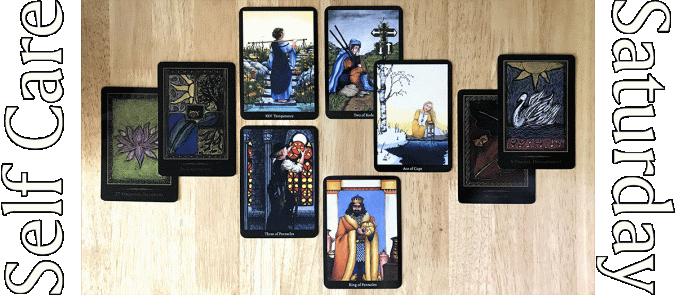
    Yes. I have a Saturday check-in spread that I do each week to help in reconnecting myself to… myself. It includes ritual bathing and meditation, followed by a time bonding with the deck I’m using at the moment and then drawing the spread and journaling it afterward.

So far, this is Part 5 of the series. Here is Part 1, Part 2, Part 3, and Part 4 for easy reference.

I’ll make another post in a few days to continue on with more questions in the challenge.

Ethony’s 31 Days of Tarot 2019 (Part 4)

45132913-tarot-cards-tarot-the-world-card-in-the-foreground-

Today, I’m again returning to another installment of Ethony’s 31 Days of Tarot challenge. But, I need to revisit the question I answered in my last response, first before moving on to the newer questions.

The question (#13) had been From the Major Arcana Cards, what card correlates to your sun, moon and rising sign? How has that resonated or played out in your life?

I realized today, while spending hours driving, that I neglected a very STRONG correlation between my sun,  moon, and rising signs and myself, and how they resonate in my life.

As mentioned, my sun sign (relating to personality) is Taurus, my moon sign (relating to emotions and inner self) is Scorpio, and my rising sign (related to how others perceive me) is Gemini.

Well so here we have the sun sign of Taurus, and the element that corresponds to Taurus is earth.  From my botany studies to my green thumb, my love of nature and the green to the way I see the world as a whole, this is the element that I most relate to.  Earth and the green are an integral part of -me-.

My moon sign, Scorpio, corresponds to the element of water.  This is the element of emotions and is my refuge.  When our D/s becomes intense and you take me into that space that so many call “sub space”, I call it “drowning”.   I find comfort in the embrace of water, whether swimming or floating, or just curled up in the bottom of the bathtub with the shower running.  I love the rain, and I’ve always found myself attracted to crystals that are water associated, such as amethyst, moonstone, labradorite, aquamarine, tourmaline, pearls, and selenite (although I hate working with the last one in jewelry).

Lastly we have my ascending (rising) sign, which is Gemini.   This sign corresponds to the element of air, which is in turn related to thoughts, judgements, logic, and the mind.  I’ve been told from time to time that I’m often perceived as “stand off-ish” and intelligent.  The one that stands back and takes everything in before choosing the right path for me.  I am fanatical about fairness and balance.   These are all qualities of that element.

Okay, and now onto a few new questions…

  1. Which tarot decks give you the most insight by way of the imagery and symbology of the cards rather than intuition or basic tarot knowledge.
    I’ve mentioned this deck before, but hands down this would have to be the Tarot of the Hidden Realms. I have never encountered a deck that spoke to me like this one does. In fact, when using it I find that my basic tarot knowledge is often the last thing that I tap into. With this deck in particular, it is all about the imagery which includes everything from the main images and facial expressions to the backgrounds, color schemes, and “mood” the artwork portrays.
  2. What is in your Tarot ‘to-go’ bag? Your Tarot travel bag.
    I actually prefer not to take my tarot or oracle decks with me when I travel. Instead, I pack playing cards and use them as an alternate, and I own a handful of decks that are specifically for this purpose. I also do not take my journals with me, but I will take notes on my phone instead.
    The reason for this is because I was raised to understand that there are some places I may travel and some people I will meet that will have such a strong adverse reaction to my faith (and items of my faith such as the tarot, pentagrams, etc) as to put me in danger. Thus, those items stay home and more innocuous items (that can be used for the same purpose) are taken in their place.
  3. What Tarot card in the deck do you look out for the most when you get a new deck? If you don’t like that card does it ruin the deck for you?
    The Hanged Man, the Two of Pentacles, and The Moon. Honestly, I check out these cards prior to ever purchasing a deck. With the internet, it’s usually pretty easy to get a look. There are times when the appearance of these cards could cause me to reject buying a deck, but most of the time, I can work with a deck even if these three cards aren’t as desirable as I’d want them to be.
  4. What is your favorite way to Tarot Journal? Planners, apps, bullet journals?
    For my daily draws, I do them here on the blog to share with you.
    I also have a yearly tarot/spirituality journal, which in the past has always been kept in a spiral bound sketch journal. I’ve been considering changing over to using a bullet journal system next year though, as I would not be stuck drawing lines on pages to keep my text straight. I’ve also been considering using the discbound system of journals, which I could still use in a bullet journal format. I need to find somewhere I can actually play with one in person and see how it feels in my hands, because I worry that structure won’t be secure enough for my liking.
    I have a “tarot study and spreads” journal that is in a Leuchtturm 1917 bullet journal.
    I’ve also recently begun the process of re-interviewing my decks. For this, I’m using a couple of lined CR Gibson journals, so that I can have one book for tarot and lenormand, and another for oracle decks and other systems. I have several of this particular journal, which will allow me to add a third or fourth as needed, if I overflow the first two in my re-interviewing process (which will happen eventually, because I use a two-page spread for the interviews).

So far, this is Part 4 of the series. Here is Part 1, Part 2, and Part 3 for easy reference.

I’ll make another post in a few days to continue on with more questions in the challenge.

Why I Own The Daemon Tarot

So this arrived in the mail yesterday…

Daemon01

And the person I had with me had a pretty visceral reaction. As in, raised voice and “what the hell did you buy, why did you buy this”, etc. Poor guy nearly had an aneurysm, I’m pretty sure.

I’m not a Christian and I don’t believe in heaven or hell, an omnipotent god or evil devil.

What I do believe in is the inherent good and evil of people. No person is all good. No person is all bad. We all have a darker side, and that is what “Shadow Work” is about. And, Shadow Work is the reason that I purchased this deck (…and a couple of others I have in my collection. I’m looking at you, Secret Tarot of Dominic Murphy.)

“The shadow-self is where you keep your anger, your resentments, your self-loathing, your grudges. Some of us display our shadows for all to see: others keep them well-hidden, and appear unbearably and disgustingly cosmic to those who don’t.” – [Aeclectic Tarot Forums]

I had to explain this to him (once he calmed down) and I figured it might be something interesting for you as well.

The term “Shadow Work” refers to Carl Jung’s references in his work to the human nature’s “Shadow Self”. This is that side of us where our hidden (and sometimes not so hidden) issues lie. Our insecurities, our negativities, our morbidities, our toxicities. Our deep seated wounds. Our destructive tendencies.

Daemon02

My mother calls Shadow Work the “Abattage des Démons” which translates into the “Slaughter of the Demons”. And that is why this deck was so intriguing for me. It’s not about evil creatures for me, but about a 69 card deck filled with all different aspects of the Shadow Self.

[Yes, 69 cards, instead of the standard 78-ish. Which means this isn’t really a tarot deck at all, nor does it carry the structure of the tarot. If what I heard is correct, the author did not want it titled with the word “tarot” but the publisher did it anyway.)

“The shadow self can be raw, dark and unbearably real and often remains as an unconscious aspect as we rather not look at why we do or say things irrationally or instinctively.” – [The Shadow Self and Tarot on Tarotpugs]

The deck is a way to explore those shadowy parts in the self, nudge at them and examine them. And perhaps, ultimately, while bringing them into the light to heal them, even if that healing is minuscule and takes countless rinse and repeats to see any real progress.

In my case, I do this most often by working with a dark deck on the first day to pull forth an issue that I need to work on, and then switching to a lighter deck the following day (or days) in order to seek a positive path that will assist me in healing what had been brought to the surface the day before.

Shadow Work is an important part of self development, and something that takes immense amounts of time, like chipping away at a wall by picking off one little granule of mortar at a time. Tools to help in these endeavors are always a good thing, and I see this deck as a tool to assist me on that path.

Daemon03

Story of the Sacred Circle Tarot

Usually, I do a group post for my deck modifications, since I’ve been doing quite a few of them over the past little bit.   But this particular modification was so surprising and so transformative, that I felt that it needed its own post.

First, a little backstory.

My very first deck was given to me, and so was my third.. fourth… possibly also my fifth.  I was raised by Pagan and Buddhist parents, and my mother gifted me the Gypsy Witch Fortune Telling cards when I was about ten years old.

Gypsy

It isn’t really a deck that I use anymore, although I still own both the deck I was originally given as well as a version of the deck that is over 100 years old.

Soon after, I was given my first Lenormand deck (which is the system that I first learned with), and then a handful more of them over the years that followed.

Blue_Owl

When I discovered the Ryder-Waite-Smith system, I was curious and eager to learn, and I requested a recommendation from the shop owner for a learning deck.   Now, I’m not sure why they recommended the Sacred Circle Tarot for this.  And, at around fourteen years old or so?  I wasn’t “centered” enough in myself or the RWS system to realize this deck was not going to be a good match for me, or to speak up and tell him “Um, no. How about a different one.”

kf3cex3h

So, I bought the deck and I struggled with it.  I slogged through the reading, and fought with the deck at every turn.  For a while, I even thought that the RWS system was just not for me, and I retreated back to my roots in the Lenormand.

I’ve moved on since then, and back to the RWS.  I’ve discovered a multitude of decks that speak to me and that I enjoy (as you can clearly see by my list of decks that I now own).  But, I never got rid of the Sacred Circle Tarot I’d struggled with so horribly in the beginning.

Recently, I’ve been doing a lot of deck modifications, and I have been eying the Sacred Circle deck with serious consideration since the first time I modified a deck.

Finally, I decided to take the plunge.   This is, hands down, my most aggressive deck modification to date, but I have to say, I’m really pleased with the results.

SacredCircle04

The first thing I did was trim the cards, of course.   You can see in the above image the difference that this made in the size of the cards.  A deck that was once oversized and on the edge of awkward has been cut down to the size of a mini deck.

It was the first card I cut that made me realize what my issue was with this deck all along, actually.   I trimmed the Tower first (because, well yeah, it was just fitting in this case), and as soon as it was trimmed, I was amazed at how much more I connected with the card.   What I realized is that those great big, highly intricate borders were what had turned me off to the deck to the point that it was nearly impossible for me to read with them or use them in any capacity.  Although there are a few borders in the Major Arcana that are beautiful, as a whole they’re impression on me is startling, garish, and in some cases an almost violent assault on the senses.

SacredCircle02

So, I cut them off.   All of them off.   The borders, the titles, the key words.   All of it but the main center picture on each card.

Suddenly, this deck felt much better.   The images spoke to me (although… not all of them), it felt good in my hands, it shuffles well and is screaming “use me, use me, USE ME!”.  The only issue I still struggle with is the “photo-shopped” imagery, which is a far and above improvement over it’s original incarnation.

I did have a small problem, though.  The Queen of Swords and the Warrior card (the Strength card) were a little too similar in my opinion, and a few of the other Major Arcana cards were easy to mix up.   The ones with people, I mean.    So, I decided to go ahead and use a fine point Sharpie and number the Major Arcana cards.

SacredCircle03

I didn’t really need to do all the cards in the Major Arcana, but I liked the consistency of having them all done, so I numbered each of them with their roman numeral correspondence.

What is not consistent is the placement of the numbers.  This is because the cards (and images) are now so tiny that there isn’t a lot of room to select any one place to put the numbers in the same spot on each card.    So instead, I tried to find wherever there was a good space that the numbers would both fit, and be visible.

Finally, I then edged the deck in black.   I did this in a less precise way than I usually do my decks.   Normally, I take each card individually and edge the card, wipe the excess with a microfiber cloth, then repeat a second time if needed.

In this case, I took sections of the deck and did the edges of these sections all at once.   This causes the ink to bleed a bit  in between the cards, adding a touch of a messy border to the fronts and the backs, which was the idea.  I think that bit of “messy’ in the border goes really well with the artwork on the cards and I’m really happy with the results.

SacredCircle01

Now?  After one night’s worth of work on altering this deck, it has been (nearly) completely transformed.  It no longer feels uncomfortable or awkward, and I no longer feel any inclination to avoid it or set it aside in the bottom of my tarot chest.  Instead, I love the way the cards feel in my hands, and aside from the photo-shopped look of some of the cards, I’m very happy with the aesthetic.