Labels and My Spiritual Path


People love to hate labels, and yet… hate to love them too. The debate goes both ways. Labels are lazy, harmful, or limiting in some way… or, labels are a “container” for a set of characteristics with the purpose of effective and clear communication

I fall in the latter category, although I see and understand the other side of the coin. The truth of the matter (at least in my observation) is that whether you hate them or love them, they’re necessary for clear communication.  

I wear a lot of labels, this post specifically is about those in my spiritual practice, though.  In one of the communities I’m a member of on Discord, a question came up asking, “Which terms do you use to talk about yourself and your craft? Why do you prefer those terms?”

Here are my answers:

  • Witch / Witchcraft – It just feels like a term that’s easy enough to communicate without confusion.
  • Pagan – Lots of people in society at large are uncomfortable with the word “witch”, and they find “Pagan” as more palatable with less negative connotations. It also feels like this term connects my witchcraft to my spiritual practice. Not all witches see that path as spiritual, but for me they are very much connected. 
  • Practitioner – Also a more “politically correct” term that makes non-witchy people more comfortable when speaking on the subject.
  • Spellwork / Spellcraft – These are the terms I grew up using when speaking of witchcraft workings.
  • Eclectic – This term fits because although I have a foundation in Wicca, I’ve been pretty much “winging it” in my own personal way for decades. I do a lot of “dabbling” in other types of witchcraft outside the ones listed below that I consider my “home base”, just to see how things work or how it feels. Sometimes these new experiences get adopted into my practice… but usually, even if they’re successful, they are not. 
  • Gray – This one is due to how my ethics work. I don’t have a lot of “set in stone rules”, and instead everything depends upon my gut/moral compass. What’s right one day may be wrong the next due to change in circumstances or other factors, and vice versa. It’s very wishy-washy, and could be viewed differently by different people as a result. 
  • Green / Forest – My practice leans very heavily into revering nature and her cycles, spending time in nature/communing with nature, researching nature, etc. This includes practicing with a wide variety of plant matter in a myriad of ways, as well as stones, crystals, soil, and other such detritus from nature.
  • Hedge – I spend time within, and draw energy from, liminal spaces. Especially liminal spaces among the trees and in forest areas. I feel that for me, this is a “sub-category” of Green/Forest.
  • Cottage / Hearth – I would say that my practice is split between Green / Forest and this category. My home is my sacred space and most everything in it is geared towards my spirituality and practice in some way.  Including things like cleaning, bathing, laundry, etc. I would also classify my jewelry making spellwork under this term. 
  • Kitchen – Ties in the Cottage/Hearth factor with the Green side of things in that one of the ways I commonly use plant matter in spellwork (and practice spellwork as a whole) is through cooking, tea making, baking, etc.
  • Tarot Reader / Cardslinger – It’s what I do. Quite literally with the word “cardslinger” since I pull my cards through jumpers instead of picking off a pile. I do a variety of other divination techniques, but using cards is pretty much “home base” for me. To be fair, I read all kinds of cards other than just tarot regularly. (ie: Lenormand, oracle, playing cards, image only cards, game cards, etc.) But the term “card reader” never seems to be something people understand, so I don’t use it.
  • Fortune Teller – I do predictive readings (usually using cards).
  • Mediumship – In my divination practice (and occasionally outside of my divination practices), I sometimes communicate with the dead.

Because I lean into experimentation, there’s a lot of other terms that could be used to describe my practices, but I feel like none of them really weigh heavily enough in my practice to break out of the “eclectic” container and stand alone on their own.  

It was an interesting exercise to look at my spirituality and practice in this way, and I feel that it helped me in seeing my own path in a more organized light.  I’d definitely encourage others to do a little examining of their own paths and see what they come up with as well. 

Remember, just because a label fits doesn’t mean you’re restricted by it. It’s just a word to help in communicating with others. After all, we don’t call a mug “that cylindrical thing that holds the hot drink made with brown beans”. We call it a mug, even when it holds paperclips instead of coffee.

Spring Preparedness

#DiscordTarotholicsFeb2023 Challenge
Prompt for February 2 : Do Spread 1

Looking Ahead Tarot Reading with The New Tarot and Visionary Enlightenment Cards

FebruaryTwo of Swords atop The Moon Rx; Occupancy

Do not allow uncertainty entry when it’s time to make decisions this month. There’s no room for more right now. Not for more things, not for more people, nor for more responsibility. Reject all suitors and stay the course instead with a “no entry” sign firmly in place.

MarchSix of Cups; Reboot

When you take your computer in this month to have its issues dealt with, don’t hold back on optional changes and repairs that need to be done. Go with the most radical option rather than waffling over the choices offered or cheaping out due to concerns over cost or expediency.

AprilThe Hierophant Rx; Impatience

When your impatience is triggered, it’s time to start looking outside the box for answers. Tried and true methods are all well and good, but sometimes creative thinking and innovation is needed instead in order to make any progress.

Other elements included in this reading:
Dried Rhododendron Leaf for Fostering Confidence
Dried Red Maple Leaf for Adaptability and Connection
Conch Shell Knot for Concentration and Clarity
Picture Jasper for Sense of Proportion and Grounding
Selenite for Purification and drawing in Positive Energy

DECK USED: THE NEW TAROT AND VISIONARY ENLIGHTENMENT CARDS

Daily Self Kindness

I didn’t retreat from social situations today, but instead went ahead and attended when what I really wanted to do was hide away at home.

Must Haves in Reading Tarot for Others

Today’s post is inspired by a prompt from the Tarot Discussion channel on the Tarotholics Discord Server.

What personality trait/skill do you think are needed to do readings for others?

I very much do believe that there are a variety of skills and qualities that a tarot reader needs to develop and possess in order to branch out into reading for others. That isn’t to say that all tarot readers that read for others have these qualities, but rather what I consider to be qualities important in a tarot reader worth going to for a reading.

In order to read for others, I feel that what is needed above everything else is a Sense of Responsibility. Reading for others isn’t a silly game and the messages you convey to a querent have far reaching repercussions. Serious damage can be done in just a few words, because while the querent is in a reading they are wide open to suggestion and trusting you not to abuse that trust. They are seeking guidance, and many querents will take what you give in a reading at face value with blind trust. This means that you need to take care with your words and messages… which leads me to the second quality.

Empathy. This is not to say someone needs to be an empath, but rather that you need to be able to listen and understand where your querent is coming from so that you can fashion your response in a way that will benefit them and not break their will, damage their hope, or take away their autonomy. This includes being able to deliver bad news in an empathetic and empowering way.

Communication Skills. It is important to have a way with words and expressing yourself that is clear and understandable to others. If you cannot properly convey your meaning and get to the point of the reading, as well as fashion your words in a way that helps the querent be receptive to what you (and the cards have to say), then the reading is going to end up a flop no matter how accurate or well meaning you may be.

Knowledge. You need to be able to read the cards and do so accurately. If you don’t know what they cards on the table mean, how can you possibly read them for someone else? I see readers now and then that don’t read the cards at all but lay them out then proceed to give their querent advice not based on the cards at all but on their own opinions. That is not giving a tarot reading.

Confidence. This is something that comes with practice, but what I am referring to here is confidence not just in your skill as a reader and your knowledge of the cards, but also in knowing what works for you, what fits for you. Trial and error and long hours with the cards help in building this confidence over time and is why many aspiring tarot readers continue to only read for themselves long after they’ve learned the card meanings… they are still growing into these methods and different techniques, and finding works best for them.

Humility. You need to be able to accept you’re not going to be right all the time. You need to be able to say “I’m sorry that this didn’t resonate for you. Maybe this was a one-off reading, or maybe it will come into fruition in the future. Sit with it a while, and keep in mind that I may have read the cards incorrectly in this case.” No one is right or accurate 100% of the time. That’s just the way it is.

The Ability to Take Criticism, and not just the constructive kind. People don’t always hear what they want to hear in a tarot reading, and some will react badly to the news no matter how empathetic or empowering you are in your delivery. Some people react in extreme ways, which can include by lashing out. Be prepared to have these clients show up from time to time… because if you read for others (especially strangers) often enough, they are going to appear before you eventually.

Some of these qualities are things that come naturally to different people. Others are qualities that one has to work on or that develop over time through life experiences. The thing is, though. I see reading for others as a responsibility, and whether you are reading for others casually or in a formal setting complete with an exchange of money, I think these qualities are important to develop and utilize in reading for others in order to make it a safe and happy experience for everyone involved.

What Do Your Readings Look Like?

I think you might have already read my response to this question, but I liked it and I wanted to include it here.

What do some of your readings look like? Do you go back and forth with the querent? Do you try breaking down their questions and reforming them if they feel a bit off? Do you go in and just see how it feels doing multiple pulls for a question?

Tarotholics Tarot Discussion Prompt via Discord on 11/7

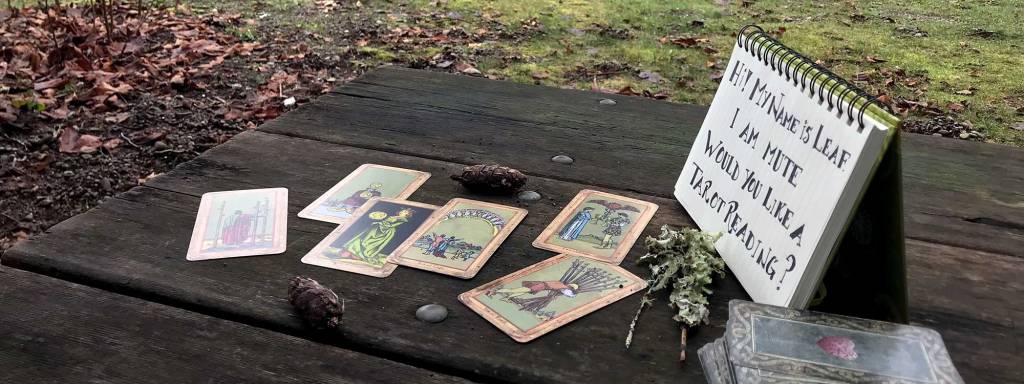
When reading for others, I read in a variety of different styles. Keep in mind I am mute, so when I say I am “talking” to someone it means I’m either typing words out in response on a device, using a text-to-speech app, or writing things down by hand for communication purposes. This slows down the process so what was once a 10 minute reading back when I had a voice is now about a 30 minute reading or more.

In Person Read then Discuss – In this method, I have a client face to face that comes to me with a question. They give me the information they want me to know and I draw cards to answer this question, and any additional rephrasing I might have that I want to add to the reading for clarification purposes. I do not look at the querent as I pull these cards, but instead I focus my attention on the cards until they are all laid out.

I take a few notes, then use either hand written, typed on a screen, or text-to-voice to convey the message of the cards in detail. Once that is done, I ask if they need clarification on anything, and if so, we talk about it and I might draw another card or two.

In Person – Free Form – Again, a face to face client sits down and we begin to talk about a situation or event that they need some clarity on. In this method, ass we talk I will continuously overhand shuffle the cards. Each time a card pops out of the deck, we pause the conversation and I use the card to help direct where the conversation goes and provide needed answers and advice.

When the discussion starts to circle back on itself, it’s an indication that we’ve reached the end of what the cards can give, and I ask if they need any further clarity. If they say yes, I might draw a card or two more if it is needed (or recap what has already been said if new cards are not needed), and then close things out.

Online – Read then Discuss – In this method, my client contacts me through digital means (usually through email or purchasing a reading off my website) and can share as little or as much of their situation as they want, as well as the purpose of the reading. From there, I draw cards based (usually) upon how many cards they’ve paid for being drawn (sometimes I draw more, which I don’t charge for).

I type out the interpretation of the cards and I send the reading to them including a picture of the cards, and give them the opportunity to ask for clarification on anything involved in the reading if needed. Said clarification may come with an extra drawn card or two, or may simply need to be a recap / rephrase of what the cards have already said.

Online – Free Form – I usually save this particular method for friends and clients that I still have that I’ve had since prior to losing my voice. Especially since the pandemic, as face to face readings are not as easy to manage these days.

This method is done using instant messages, texts, DMs or other instant messaging type of method, we talk about what’s going on with them and between my replies while they are typing and while I’m reading, I shuffle cards and allow cards to pop out to provide guidance, advice, and answers.

Like an in person free-form reading, this is a discussion. I take pics of the cards along the way and send them to my client/friend as we go.

When the discussion either circles back or starts to peter out, it means the reading is then drawing to an end and I make sure they don’t need clarification on anything. I then send them a picture of their full reading with all of the cards on the table to close things out.

#IAmAFortuneTeller (non) VR to Mary-Grace Fahrun

Okay, so the Pagan Perspective is definitely on a holiday break.  So, I decided to do one of my (non)VRs today in place of a response to their regular videos.

One of my favorite content creators, Mary-Grace Fahrun, did a video on YouTube at the end of November about how she uses tarot and about the stigma behind the use of cartomancy for predictive readings. She included a tag for responses, and I very much enjoyed her video and wanted to do a response.

glass

Like Mary-Grace, I grew up with cartomancy. In my case it was Lenormand cards, then playing cards, and then tarot. In my experience, Lenormand in particular is all about handing you a roadmap of potholes along your path.

I don’t know where the judgement against predictive readings stemmed from, or why it is so prevalent among modern day readers, but it is very prevalent and highly frowned upon by a large majority of card readers out there.

Somewhere in my teens was when I ran into this issue.  I was told that 3rd party readings and predictive readings are ethically wrong, and for a while I fought against using the cards in that way… but honestly? I gave up on that rather quickly.

Interestingly, I am not as strong at reading the past as I am at reading the present and future.

Intuition is intuition, and that information is going to come through whether I want it to or not. So I had a good look at my own moral compass and values and decided that for me? Both 3rd party and predictive aspects are a part of it, or I don’t read cards… because it just comes naturally. And I sure as hell am not hanging up my decks!!

I honestly do not understand why it is considered taboo or why people look down their noses at readers that do fortune telling (predictive readings, telling the future, etc).  I’ve had people say it’s about clients seeing the predictions as written in stone, or taking away choice, etc.  But the fact is?   That is in the presentation, NOT in the predictive aspect.

Doing predictive readings requires the responsibility and sensitivity to make sure those you read for are aware of the fluidity of the future, and how even just having the reading can have the possibility of changing the results, because knowledge is power.  It requires empowering people, so that they can build the future that they want, and be prepared for what is coming.

Any tarot reader, no matter the type of readings they do, has the ability to take away people’s choices and diminish their power.  Not just during predictive readings.  You are tapping into their needs and wants, desires, fears, and the depths of their psyche.  And that requires sensitivity and respect and a sense of responsibility.

So yes… I am a fortuneteller.  I am not ashamed of that.  It’s how my intuition works and fighting against my intuition or ignoring my intuition’s voice is just… not the path for me.