Personal Emotions and Reading Tarot

So, I had something else planned to post today, but then this topic kind of came up the other night in my mind while I was reading on the Philosophical Question about pleasure and evil. The thing is? I really did think that the answer was going to be a yes… and it wasn’t. It got me to thinking about how we all sometimes invest our own thoughts, opinions, or emotions into tarot reading. The “good readers” realize this when it’s happening, and are able to then step back from it and let the cards speak for themselves.

Usually, when people discuss times to take a break from reading tarot, at the top of that list is times when you are emotionally imbalanced. And I agree with this. When you are dealing with depression or anger, grief or other intense emotions, it’s not usually a good time to be reading tarot because your inner turmoil can influence your perspective on the cards and what they say.

This can, in turn, can create problems if you’re reading for yourself or others by causing the reading go awry from the intended message in the cards, or not be delivered in the healthiest ways.

In thinking about this topic after that reading I mentioned above, I was thinking about why it is that I’m still doing readings during this time when I’m dealing with my own depression. Shouldn’t I have stepped away from the cards? That’s what I have done in the past during these times, and it’s the safest thing to do usually.

But, I haven’t stepped back. I’ve cut down a bit with how many readings I’m doing, but I haven’t stopped entirely or cut back to just my “Positive Message” card of the day practice.

The thing is, though, although I am not reading for others right at the moment, because I’m going through a depression and need to make sure my delivery to my clients remains the caring and understanding tone that it always should be… I am continuing to read for myself.

This is not something I recommend, because of the reasons I already mentioned. That said, I am trying to see if I can level out my ability in reading even during these emotional times. Not just in this particular issue, but more… across the board whether happy or sad, depressed or upset, etc. I would like to grow to a point where my intuition and “reader’s voice” are not warped by my emotional balance and struggles, but instead continue to be objective and unbiased through these times.

This doesn’t mean that I would at some time in the future begin reading for others during these times when I’m struggling… but I think that even in just reading for myself this is something I can work on to become a better reader over all.

Must Haves in Reading Tarot for Others

Today’s post is inspired by a prompt from the Tarot Discussion channel on the Tarotholics Discord Server.

What personality trait/skill do you think are needed to do readings for others?

I very much do believe that there are a variety of skills and qualities that a tarot reader needs to develop and possess in order to branch out into reading for others. That isn’t to say that all tarot readers that read for others have these qualities, but rather what I consider to be qualities important in a tarot reader worth going to for a reading.

In order to read for others, I feel that what is needed above everything else is a Sense of Responsibility. Reading for others isn’t a silly game and the messages you convey to a querent have far reaching repercussions. Serious damage can be done in just a few words, because while the querent is in a reading they are wide open to suggestion and trusting you not to abuse that trust. They are seeking guidance, and many querents will take what you give in a reading at face value with blind trust. This means that you need to take care with your words and messages… which leads me to the second quality.

Empathy. This is not to say someone needs to be an empath, but rather that you need to be able to listen and understand where your querent is coming from so that you can fashion your response in a way that will benefit them and not break their will, damage their hope, or take away their autonomy. This includes being able to deliver bad news in an empathetic and empowering way.

Communication Skills. It is important to have a way with words and expressing yourself that is clear and understandable to others. If you cannot properly convey your meaning and get to the point of the reading, as well as fashion your words in a way that helps the querent be receptive to what you (and the cards have to say), then the reading is going to end up a flop no matter how accurate or well meaning you may be.

Knowledge. You need to be able to read the cards and do so accurately. If you don’t know what they cards on the table mean, how can you possibly read them for someone else? I see readers now and then that don’t read the cards at all but lay them out then proceed to give their querent advice not based on the cards at all but on their own opinions. That is not giving a tarot reading.

Confidence. This is something that comes with practice, but what I am referring to here is confidence not just in your skill as a reader and your knowledge of the cards, but also in knowing what works for you, what fits for you. Trial and error and long hours with the cards help in building this confidence over time and is why many aspiring tarot readers continue to only read for themselves long after they’ve learned the card meanings… they are still growing into these methods and different techniques, and finding works best for them.

Humility. You need to be able to accept you’re not going to be right all the time. You need to be able to say “I’m sorry that this didn’t resonate for you. Maybe this was a one-off reading, or maybe it will come into fruition in the future. Sit with it a while, and keep in mind that I may have read the cards incorrectly in this case.” No one is right or accurate 100% of the time. That’s just the way it is.

The Ability to Take Criticism, and not just the constructive kind. People don’t always hear what they want to hear in a tarot reading, and some will react badly to the news no matter how empathetic or empowering you are in your delivery. Some people react in extreme ways, which can include by lashing out. Be prepared to have these clients show up from time to time… because if you read for others (especially strangers) often enough, they are going to appear before you eventually.

Some of these qualities are things that come naturally to different people. Others are qualities that one has to work on or that develop over time through life experiences. The thing is, though. I see reading for others as a responsibility, and whether you are reading for others casually or in a formal setting complete with an exchange of money, I think these qualities are important to develop and utilize in reading for others in order to make it a safe and happy experience for everyone involved.

What Do Your Readings Look Like?

I think you might have already read my response to this question, but I liked it and I wanted to include it here.

What do some of your readings look like? Do you go back and forth with the querent? Do you try breaking down their questions and reforming them if they feel a bit off? Do you go in and just see how it feels doing multiple pulls for a question?

Tarotholics Tarot Discussion Prompt via Discord on 11/7

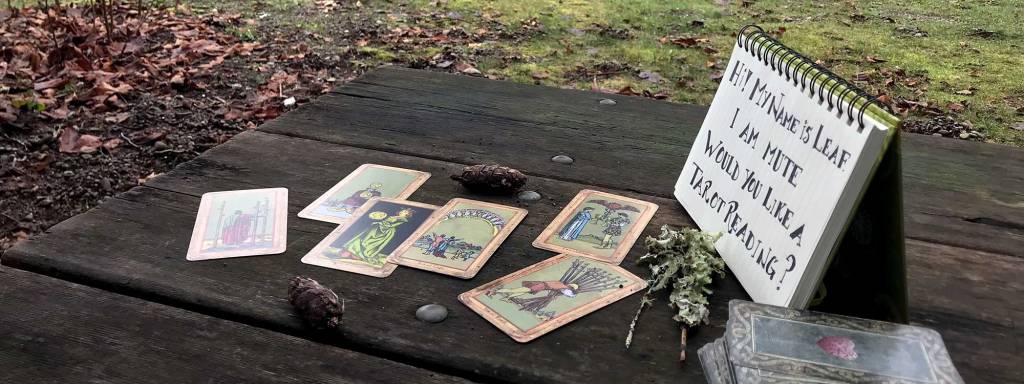
When reading for others, I read in a variety of different styles. Keep in mind I am mute, so when I say I am “talking” to someone it means I’m either typing words out in response on a device, using a text-to-speech app, or writing things down by hand for communication purposes. This slows down the process so what was once a 10 minute reading back when I had a voice is now about a 30 minute reading or more.

In Person Read then Discuss – In this method, I have a client face to face that comes to me with a question. They give me the information they want me to know and I draw cards to answer this question, and any additional rephrasing I might have that I want to add to the reading for clarification purposes. I do not look at the querent as I pull these cards, but instead I focus my attention on the cards until they are all laid out.

I take a few notes, then use either hand written, typed on a screen, or text-to-voice to convey the message of the cards in detail. Once that is done, I ask if they need clarification on anything, and if so, we talk about it and I might draw another card or two.

In Person – Free Form – Again, a face to face client sits down and we begin to talk about a situation or event that they need some clarity on. In this method, ass we talk I will continuously overhand shuffle the cards. Each time a card pops out of the deck, we pause the conversation and I use the card to help direct where the conversation goes and provide needed answers and advice.

When the discussion starts to circle back on itself, it’s an indication that we’ve reached the end of what the cards can give, and I ask if they need any further clarity. If they say yes, I might draw a card or two more if it is needed (or recap what has already been said if new cards are not needed), and then close things out.

Online – Read then Discuss – In this method, my client contacts me through digital means (usually through email or purchasing a reading off my website) and can share as little or as much of their situation as they want, as well as the purpose of the reading. From there, I draw cards based (usually) upon how many cards they’ve paid for being drawn (sometimes I draw more, which I don’t charge for).

I type out the interpretation of the cards and I send the reading to them including a picture of the cards, and give them the opportunity to ask for clarification on anything involved in the reading if needed. Said clarification may come with an extra drawn card or two, or may simply need to be a recap / rephrase of what the cards have already said.

Online – Free Form – I usually save this particular method for friends and clients that I still have that I’ve had since prior to losing my voice. Especially since the pandemic, as face to face readings are not as easy to manage these days.

This method is done using instant messages, texts, DMs or other instant messaging type of method, we talk about what’s going on with them and between my replies while they are typing and while I’m reading, I shuffle cards and allow cards to pop out to provide guidance, advice, and answers.

Like an in person free-form reading, this is a discussion. I take pics of the cards along the way and send them to my client/friend as we go.

When the discussion either circles back or starts to peter out, it means the reading is then drawing to an end and I make sure they don’t need clarification on anything. I then send them a picture of their full reading with all of the cards on the table to close things out.

What Kind of Reader Am I? #THEREADERIAM (non)VR to James Feeney

So although this tag originally comes from James Feeney on YouTube, it was actually first brought to my attention by Casper the BoyDiviner.
ScatterTarot11

What is the primary system of divination you use (as specific as possible)?

Recently, I’ve been sticking mostly to tarot cards, and the occasional image-only cards or oracle cards, unless I have a client making a request for something else specifically.

Who do you read for?

Paying clients.  Myself.  Friends and loved ones. Random occasional strangers when I’m feeling the urge to offer a free reading here and there.

What types of readings do you normally do? (ie: topics, spreads, time, medium)

I specialize in intuitive reading that incorporates an element of predictive reading.  I do well with the present and the future, but I do not do past readings whether that be past lives or someone’s personal past.  I also rarely do predictive readings that span more than three months ahead.

I’m good with a variety of topics with the exception of mediumship, which I am not prepared to offer. I usually let my moral compass guide me on whether or not a question or topic is okay to do… and I avoid those topics that could put me in legal jeopardy.

I prefer free-form readings over spreads most of the time, but do spreads on request or when reading for myself as reading for myself requires a bit more structure sometimes.

What is your reading style? (ie: analytic, intuitive, spiritual/ predictive or fortune)

I think I pretty much covered this above when I mentioned the types of readings I do.  My reading style is intuitive interpretation of the imagery, which I then augment by including traditional meanings of the cards as a secondary contribution to the reading.

The exception to this is excessively pip decks, lenormand, and playing cards.  With these three systems it is the opposite.  Because these styles of decks are not imagery rich, they don’t provide enough input for me to allow my intuition free reign off of the imagery.  In these cases, I lean heavily on numerology and/or foundational meanings within those systems, and then incorporate a more “directional based” intuition into that foundational knowledge.

Although my readings are not secular, that is between me and my concept of divinity (and possibly also my spirit guides), and therefore rarely reflects in my delivery to others.

What types of readings do you conduct? (ie: evaluative, coaching, empowering, reflective)

All of the above.  It really just depends on what the client needs.  In the case of reading for myself, it is usually either evaluative or guidance towards self care, life balance, and a healthy well-being.

ReadingWhat is your ideal reading atmosphere?

Outside. A picnic table.  Bare feet to bare earth with weather warm enough to make that comfortable but not so hot as to feel uncomfortable. Overcast or bit of shade and a slight breeze but not windy.  Not raining. Lots of grass and trees.

Reversals? Jumpers? Shuffling style?

Reversals – Occasionally.  Only when it really calls to my intuition that the card was meant to land that way and looking at it upright just feels… wrong.  Otherwise I use my intuition to tell me what message the cards want to convey, no matter the orientation of the card on the table or if that message is a reversal meaning or an upright one.

Shuffling Style –  When I first add a deck into my collection (or after I have reorganized it back into its suits for some reason) I will then riffle shuffle a deck at least 7 or 8 times before using it.   This is because mathematically speaking, you need to riffle shuffle a deck of 52 cards at least 7 times to effectively randomize the deck.

After that, though?   When I do a reading, because the cards are already randomized I will usually riffle shuffle about three times before handing the cards to my client for them to shuffle them a few times.

Jumpers – I use jumpers to pull my cards.   So after I have done the riffle shuffling, I will then shift to a seesawing overhand and, with my question in mind, wait for a card (or two) to fall out, then repeat for the next question, and the next, etc.  So essentially, all of my card pulls are jumpers.  If I receive more than two cards at a time, I will put them back in the deck and ask for a more succinct answer.

What is your delivery tone? (ie: constructive, positive, reflective, action-oriented)

All of the above, but not at the same time?  That is to say that deep down in my psyche, I’m essentially a “fixer”.  Meaning, essentially, that I don’t want to know things just to know things. I want to know things so that I can move forward, improve, or somehow adjust and/or fix something.  I have no problem delivering the hard answers or even the harsh answers, but I do it with a little bit… more.

So even though the question might be “how am I physically at this time”, when I’m asking the question? I’m really looking for more than just a status update… so when the cards answer me, they are going to give me more than just a status update. They’re also going to provide me with a path to improvement/betterment.

This is the same whether I’m reading for myself or someone else.

What are some of your personal reading quirks? (ie: correspondences you tend to draw on, habits you have, little details that you alone use and have)

I’m not exactly sure how to answer this, because in my observation everyone reads the cards differently.  Especially when you start delving into those that read the cards intuitively.   Just as there are many different ways for intuition to speak to someone, there are even more ways for us to take and utilize that inner voice in our tarot readings.

I think I’ve outlined a few of the oddities above.  Possibly the most notable being my method for pulling cards. I also think that my need to teach others is somewhat unique.  To be honest I’ve been doing this so long that it’s hard for me to tell anymore what’s the “status quo” norm of the masses, and what’s unique to me and my personal style.