I work in a nursery as one of my part time jobs, and whenever I see someone buying these, I always take a minute to stop them and ask if they understand what they’re for and how they’re used.
What I’ve found is that most people have no idea. They seem to think that by using this little glass globe of water, somehow their plant’s needs will magically change to match the volume of water the bulb can hold.
It is true that the watering bulb is meant to water one’s plants. Yes, it is. But that’s not really its true purpose.
Watering bulbs are not meant to take the place of regularly watering your plants. Rather, the purpose of a watering bulb is to extend the time between watering, and give you a visible gauge of when it’s time to water your plants again.
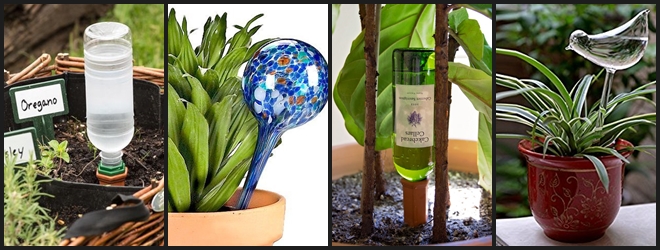
They come in a variety of different shapes and sizes, and even in different names from watering bulb, to watering globe, to plant nanny. But their purpose is always the same, as is how they should be used.
First, you water your plant normally. Saturate the soil with water. Unless your soil is so dry it’s turned rock hard, a good gauge of this is when the water begins dribbling out the bottom of the pot. (For pots without a drainage hole, be sure that you don’t water too much and create a swamp in the bottom of the pot. No plant is going to be happy about that, except possibly a peace lily.)
Second, fill your watering bulb with water and grab a dinner knife from the kitchen. (A pencil or pen may also work, but I usually find them to be too small for the task at hand.)
Third, return to your plant. Insert the knife into the soil where you want to put the globe (usually 2 inches from the stem is best) and rotate to make a hole then pull out the knife. Put your finger over the globe’s stem to plug before inverting, then stick the stem into the hole.
Once you’ve made a hole for your watering bulb, you won’t need the knife again, as you can reuse the same hole again and again.
With a plant nanny, the process is the same except that there is a stake you insert into the soil after its wet, which serves as a permanent hole the watering stem (or bottle neck, depending on the style of plant nanny) is inserted into.
Note the first step. YOU WATER your plant BEFORE you put in the watering bulb / globe / plant nanny.
Your plant will then suck up the water in the soil first. And, as the soil dries, it will then wick moisture from the watering bulb until the bulb is empty. When you see your watering bulb is empty, you then know it is time to repeat steps 1-3.
A watering bulb won’t magically make your plants need less water, but it will extend the time between watering and help us humans in knowing how much water a plant needs, and how often we need to water them. Use them properly, and you’ll never have to worry about under-watering or over-watering your plants again.
 Twisting the Leaf