Back in October, LadyKnight of Avalon on YouTube did a video where she talked about deck collections and how we go about the process of curating our personal collections over time. The fact is that I have a rather large deck collection, and not just of tarot but also playing cards, oracle cards, lenormand, and other game cards and cartomancy cards. I love decks of cards. I love the diversity of artwork available and the variety “voices” that the different styles of artwork speak with.
Anyway, she devised this list of questions for those that shop for and collect decks, no matter the size of your collection. So here we go….

1. What was the last deck you bought and why that one?
The last deck I bought was the Divine Muses Oracle. I actually saw this one on Kickstarter when it was being launched, and I waffled on it and ended up not backing it because some of the cards didn’t appeal to me all that much (Ancestors, Astral Ascent, and the Muse of Art cards, for example). But since then I have seen this deck on many videos and images, and I’ve been SUPER attracted to it and had some of the cards really stand out to me super strongly (such as the Totem of Water, Lattice of the Soul, and Raven King). In the end, I decided that the cards that really spoke to me outweighed the cards that I was a bit “meh” on and I picked it up to see how I could get on with it.
2. What’s your decision process when you buy a new deck?
Does the imagery on the deck speak to me? Will the words get in my way? If so, can they be removed? Is it worth (to me) what they’re asking for the deck? Can I afford to buy it? Is it something I want to buy right now, or do I want to wait and see if I still want it in a few weeks?
3. What are deal-breakers in a deck that keep you from buying it?
Well at the top of the list is if I can’t connect with the imagery. If the imagery doesn’t speak to me then there’s just no point in buying the deck. Other deal-breakers include a Hanged Man card or Two of Pentacles card that I just can’t work with, super crappy cardstock (I’m a riffle shuffler… if it can’t handle being riffle shuffled then there’s no point in me owning it), too few cards for too much money, or well… too much money in general because if it’s out of my price range? Then it’s out of my price range.
4. Little white book or big guide book?
I don’t really care as long as there is quality content. I’ve seen some spectacular little white books…. and I’ve seen some big guide books that are just sheer crap.
5a. Do you have new deck rituals?
Yes. When I get a new deck, I like to do a cleansing and a deck interview. Unless I allow others to handle the cards, or for some reason the deck’s communication starts to feel “muddled”, chances are that this is the only time the deck will ever be cleansed while in my possession.
5b. How do you break in a new deck?
By using them. Also, meditative shuffling. And, sometimes, with deck modification as well such as edging and/or trimming the deck if feel that it needs it.
6a. Have you ever been disappointed after getting a deck because it looked/felt different than expected?
Yes. Usually this has to do with how it communicates with me. There have been times I’ve purchased decks and when I get them in my hands I just can’t get them to communicate as clearly as I’d like. The most prominent example of this is the WildWood Tarot, which has artwork of a theme and style that I felt should have spoken to me very clearly, but even after years of trying, I couldn’t manage to work with them very well. (It turns out, cutting off the titles on the cards so that it is artwork-only finally solved this issue for me.)
6b. Have you ever been pleasantly surprised by a deck after getting it?)
Yes. Most recently? The This Might Hurt deck, which I backed on Kickstarter in the spring and just arrived this week. It was far and above the quality I was expecting and I’ve been avoiding walk-throughs and other images of the cards, etc because I wanted it to be a surprise.
7. Do you interview new decks?
Usually just when it first comes into my collection, although if I feel that the “tone” of a deck’s readings have changed over time then I will do it again to re-familiarize myself with the energy of the deck and it’s “voice”.
8. Do you ever buy decks for a specific purpose (only using it for that one?)
Yes. I have a few decks that are solely for my personal use. I have a few that are solely for shadow work. And I have a few that I’ve purchased solely to use in one-card draws.
I have also occasionally bought a bootleg deck or two for the purposes of spellwork, because often in those cases the deck is destroyed in some way in the process of the spell casting. Destroying a $5 deck in a spell is one thing. Destroying a $50 deck in a spell is quite another.
9. Do you differentiate between decks you buy for yourself and decks you would use for other people?
Only in a few special cases. The vast majority of my decks are open to be used for both.
10. What is one thing you wish deck creators would do, do more of or stop doing?
Do: I wish more deck creators would consider cardstock as a top priority. (Hello Llewellyn, I’m talking to you.)
Do More: I’m all for more illustrated pip cards. I hate it when you have glorious and beautifully done Majors, and then the Minors are just sparingly done pips; or else they are illustrated, but in a way that makes it clear not as much effort was put into them as the Major Arcana.
Stop Doing: This one is specifically for creators on Kickstarter. A lot of creators on that platform add on “Stretch Goals” which is great, but I really wish that they would focus less on little trinkets, pins, fancy boxes, etc….. and more on upgrading cardstock and making the actual CARDS nicer.
 First, I have to explain what a “spread” is. Essentially, in the tarot (or any fortune telling that involves cards) there are two “basic” methods for using the cards. (I’m sure there are a variety of other more esoteric ways as well, but I’m only covering the two basic methods.)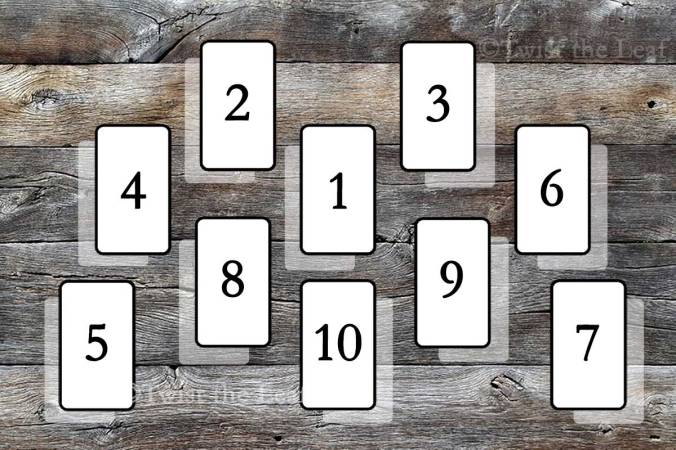
 Twisting the Leaf